Buy Now
Multiple Buying Options Available
Rating:
5/10
WIRED
Affordable. Decent camera. Long software support. Nice AMOLED screen. Day-long battery life. Expandable storage.
TIRED
Frustratingly slow performance. No headphone jack.
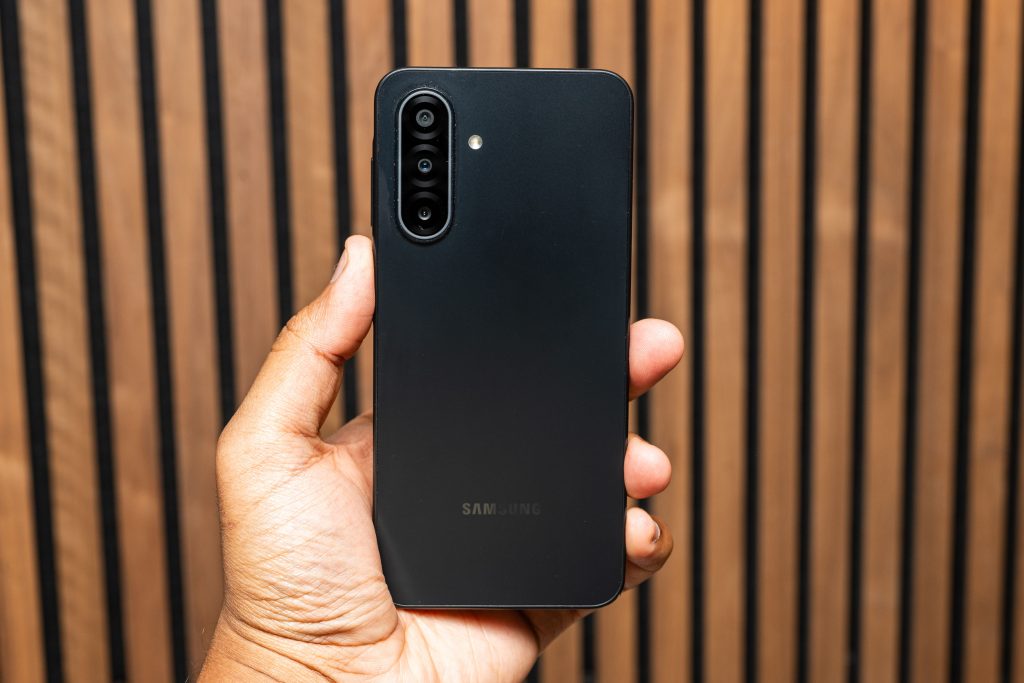
“Camera failed.” That was the first time I tried to look at a photo I captured on Samsung’s $200 Galaxy A17 5G smartphone. I’ve now spent more than two weeks using it as my primary phone, and I can’t wait to switch to something else.
Yes, it’s $200, so expectations shouldn’t be high, but I didn’t have as frustrating an experience with the same-priced Motorola Moto G (2026) I tested a month prior, and I’d argue you’re better off waiting for a $300 phone to go on sale for an overall richer experience. It’s unfortunate because the Galaxy A17 5G does have some great qualities, but you can’t trust it to be reliable.
Low Memory
.png)
Photograph: Julian Chokkattu
The biggest problem with the Galaxy A17 is performance—it’s powered by Samsung’s Exynos 1330 chipset, but you can more specifically lay the blame on the limited 4 GB of RAM. International versions of this phone come with 8 GB of RAM, and I daresay they perform better. Many of the performance woes happen when you try to do one too many things simultaneously.
The worst offender is the simple swipe up from the bottom to go home or to switch to a previous app. With gesture navigation turned on, the Galaxy A17 constantly thought I wanted to trigger Google’s Circle to Search feature, which would cause the phone to freeze and stutter until it finally loaded the capability. It was so bad that I eventually had to turn Circle to Search off.
Forget trying to multitask. I’d be filling out a form or reading a story in Google Chrome, but if I switched to another app and then came back to what I was doing, the Galaxy A17 would often refresh the entire app again, causing me to lose progress and start over.
Even notifications came through slowly sometimes. When I’d try to log into a service and get a one-time password for security, the texts would never come through until I actually loaded up the Messages app. Notifications from Google Home for my security cameras came through at first, but over time, they became sporadic, and sometimes never arrived despite seeing them on my other devices. Sometimes when I hit “Delete” on email notifications, the notification just stayed there unchanged.
.png)
Photograph: Julian Chokkattu
Even without juggling various tasks, performance is sluggish in general. You’ll wait a full second or two after swiping down on the home screen just to see your notification drawer. App launches take a beat, and scrolling through Instagram is choppy despite the 90-Hz screen refresh rate. A lightweight game Pako Forever was also very stuttery; playable, but not very enjoyable.
There are moments when performance is perfectly manageable—after all, I have used this phone for more than two weeks, and it’s not at the bottom of a lake (yet). But those lag spikes make it very inconsistent, and if there was a moment when I really needed to do something quick on my phone, I wouldn’t trust the A17 to handle it.
My benchmark scores aligned with my real-world assessment. The A17 ranked slightly higher than Motorola’s $200 Moto G in single-core performance, but much lower in multi-core performance, indicating that the Motorola device generally has it beat when you’re juggling multiple apps. That makes sense, because I do not recall having as frustrating an experience with the Moto G when I tested it a month ago. Don’t get me wrong, that phone is also very slow and annoying to use, but I wasn’t this flabbergasted.
The Good Bits
I haven’t had any issues with the 6.7-inch AMOLED display—it gets bright enough in sunny conditions, and it’s sharp enough. The single mono speaker is serviceable, though it’s easy to block when holding the phone in landscape orientation. There’s a microSD card slot to expand on the 128 GB of storage, the phone is IP54-rated to withstand rain, contactless payments have worked OK, and the fingerprint sensor is reliable. GPS has been fine, though Google Maps can sometimes glitch out, especially if you try to do something else while navigating.
I’ve dropped the A17 a few times (less than 2-foot drops), and it has held up surprisingly well, so it gets an A+ for durability. If it matters to you, there is no headphone jack here (Motorola retains it on the Moto G). It’s also great to see that this phone will receive six years of software updates, far better than anything Motorola offers at this price. There’s a good amount of bloatware you’ll want to remove, but the software experience is otherwise similar to other Samsung phones. If you’re a fan of One UI, you’ll feel at home here.
Samsung has stuffed a 5,000-mAh cell here, but battery life is rather unremarkable. It lasts a full day with average to heavy use, but if you use the phone sparingly, then it’ll easily stay alive through a second day. There’s no wireless charging, unsurprising for a budget phone, but 25-watt wired charging means it’s not terribly slow to recharge.
.jpg)
.jpg)
.jpg)
1 / 8
Photograph: Julian Chokkattu
Main camera.
The main 50-MP camera is where Samsung beats its Motorola peer more decisively. When it finally loads and takes the picture (be patient), the images it spits out are decently detailed and not too oversaturated. Things take a turn for the worse in low light, with significantly more grain and loss of detail in darker areas. Moving subjects in low light? Just forget about it. Overall, though, it’s a passable camera. Just don’t bother with the 5-MP ultrawide or 2-MP macro.
If your budget is strictly limited to $200, I would buy the Moto G 2026 over the A17, even with its inferior screen and lackluster two-year Android OS upgrade policy; the Motorola looks much nicer and simply performs better. But I urge you to just a little bit more cash. The smarter move is to be patient and wait for $300 smartphones, the Moto G Power 2026, to inevitably go on sale. In a few months, expect it to dip below $250. Samsung will also ly release a $300 Galaxy A27—succeeding the Galaxy A26 from 2025—in a few months, and it will be a better buy if you can wait for a sale.
Or you could just buy used and yourself the frustration. Swappa, for example, has the Galaxy S23—just two generations behind—unlocked in good condition for $236. That’s a flagship smartphone from 2023, meaning it’ll deliver significantly better performance, not to mention a great camera system. Yes, the Galaxy A17 is a usable $200 smartphone, but do you really want something that’s going to annoy you every single day?
Sumber Artikel:
Wired.com