Text settings
Story text
SmallStandardLargeStandardWideStandardOrange
* Subscribers only
Learn more
As more than 120 million people tuned in to the Super Bowl for kickoff on Sunday evening, SpaceX founder Elon Musk turned instead to his social network. There, he tapped out an extended message in which he revealed that SpaceX is pivoting from the settlement of Mars to building a “self-growing” city on the Moon.
“For those unaware, SpaceX has already shifted focus to building a self-growing city on the Moon, as we can potentially achieve that in less than 10 years, whereas Mars would take 20+ years,” Musk wrote, in part.
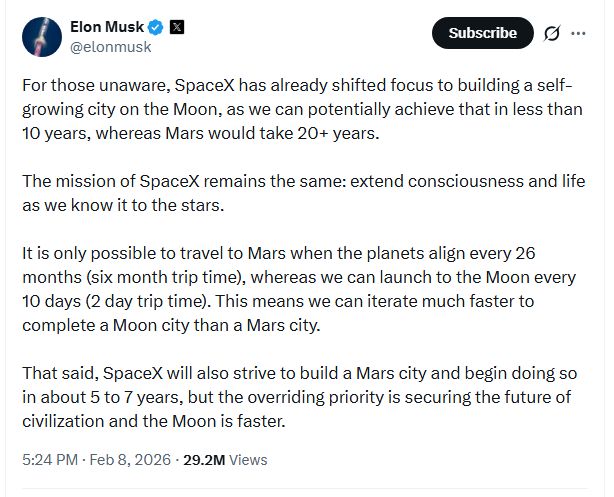
Elon Musk at 6:24 pm ET on Sunday.
Credit: X/Elon Musk
Elon Musk at 6:24 pm ET on Sunday. Credit: X/Elon Musk
This is simultaneously a jolting and practical decision coming from Musk.
Why it’s a jolting decision
A quarter of a century ago, Musk founded SpaceX with a single-minded goal: settling Mars. One of his longest-tenured employees, SpaceX President and Chief Operating Officer Gwynne Shotwell, described her very first interview with Musk in 2002 to me as borderline messianic.
“He was talking about Mars, his Mars Oasis project,” Shotwell said. “He wanted to do Mars Oasis, because he wanted people to see that life on Mars was doable, and we needed to go there.”
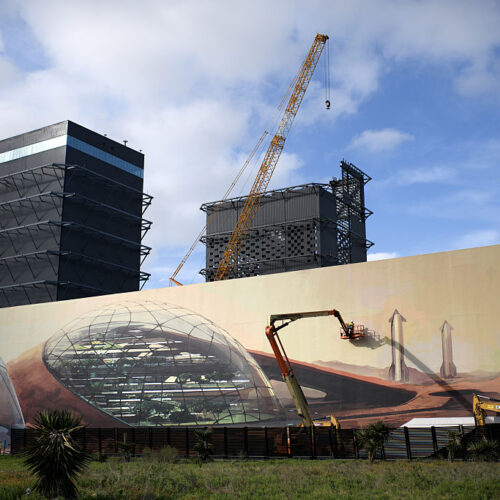
She was not alone in this description of her first interaction with Musk. The vision for SpaceX has not wavered. Even in the company’s newest, massive Starship rocket factory at the Starbase facility in South Texas—also known as the Gateway to Mars—there are reminders of the red planet everywhere. For example, the carpet inside Musk’s executive conference room is rust red, the same color as the surface of Mars.
In the last 25 years, Musk has gone from an obscure, modestly wealthy person to the richest human being ever, from a political moderate to chief supporter of Donald Trump; from a respected entrepreneur to, well, to a lot of things to a lot of people: world’s greatest industrialist/supervillain/savant/grifter-fraudster.
But one thing that has remained constant across the Muskverse is his commitment to “extending the light of human consciousness” and to the belief that the best place to begin humanity’s journey toward becoming a multi-planetary species was Mars.
Until Sunday night.
Why it’s a practical decision
We cannot know Musk’s full rationale for pivoting to the Moon, at least in the near term. Only a year ago, he referred to the Moon as a “distraction.” But now, apparently, it’s not. What we can do is look at what has changed in the last 13 months.
The first change is that the one company with the potential to seriously challenge SpaceX in spaceflight over the next decade, Jeff Bezos’ Blue Origin, has finally started to deliver. The company has now flown and landed its New Glenn rocket. Multiple sources have told Ars that Bezos has told his team to go “all in” on lunar exploration. This includes the development of a crew transportation system, Blue Moon Mark 1.5, that does not require orbital refueling. This raises the possibility that Blue Origin might land humans on the Moon before Starship, a threat sources at Starbase say SpaceX is beginning to take seriously.
The other major change is Musk’s obsession with artificial intelligence and his view that AI and space are increasingly intertwined in their ambitions. SpaceX and xAI recently merged, and a major focus of Musk going forward will be to construct orbital data centers to provide enormous computing resources for his vision of humanity’s online future.
He has also spoken increasingly of becoming a Kardashev-level civilization, a reference to a Soviet astronomer who conceived that humanity would advance by first being able to tap and store all energy sources available on its planet, and then by directly collecting a star’s energy through technology a Dyson sphere. Musk has also made frequent references on social media to building a “mass driver” on the Moon.
All of this may sound it’s straight out of the pages of a science-fiction novel, and it pretty much is. But the reality is that the Moon has reliable stores of oxygen and silicon, and building a catapult-mechanism on the airless world would be an efficient way to move materials into space to build large orbital factories, data centers, solar farms, or even O’Neill cylinders.
In this, Musk is starting to sound a lot more Bezos when it comes to his vision for human habitation in space, rather than the Mars-first advocate he has always been.
One other sobering thing to think about in terms of a lunar mass-driver: it is potentially an extremely potent weapon to threaten Earth with large projectiles. We cannot know if Musk has had any conversations with US military officials about this, but anyone who has read The Moon Is a Harsh Mistress by Robert Heinlein will understand Luna’s position as the ultimate high ground. And the US Space Force is not ignorant of this.
So what does all this mean?
In the short term, it does not mean a whole lot. To anyone paying attention, SpaceX was not on track to send a Starship to Mars in 2026, and the 2028 window was looking rather unly as well. Mars was always in the distance, and now it will remain so.
By focusing on the Moon, Musk is making a decision that benefits NASA and the United States. Because for all of Blue Origin’s promise with a slimmed-down lunar lander, Starship offers a promising avenue to return humans to the Moon in the near term.
Another advantage of Starship is its enormous payload capacity, able to bring 100 metric tons or more of cargo down to the Moon. For anyone seeking to build a commercial business on the Moon, Musk’s 180-degree pivot represents an enormous opportunity.
For Mars advocates, however, Musk’s turn is a bitter pill to swallow. There have long been many dreamers who spoke of settling Mars, but only Musk actually built the hardware and financial war chest to make such dreams a reality. And it is true that, in the long term, Mars offers a more favorable (although still inhospitable) environment for human settlement, with a thin atmosphere, water ice both on the surface and beneath the ground, methane, and more.
But those dreams are now deferred as Musk has bowed to a harsh reality: The Moon may be hard, but it is a lot easier to develop than Mars, which is only accessible every 26 months when the planets align.
Eric Berger Senior Space Editor
Eric Berger is the senior space editor at Ars Technica, covering everything from astronomy to private space to NASA policy, and author of two books: Liftoff, about the rise of SpaceX; and Reentry, on the development of the Falcon 9 rocket and Dragon. A certified meteorologist, Eric lives in Houston.
Sumber Artikel:
Arstechnica.com