
Taking place in Scottsdale, Arizona, from May 12–14, 2026, DTECH Data Centers & AI brought together utilities, data center operators, EPC firms, and technology providers to explore how to resolve the challenges posed by AI-powered load growth. While effectively navigating this once-in-a-century structural shift was a central theme of this year’s event, questions about where and how we’ll find the power to meet this demand came up in numerous discussions.
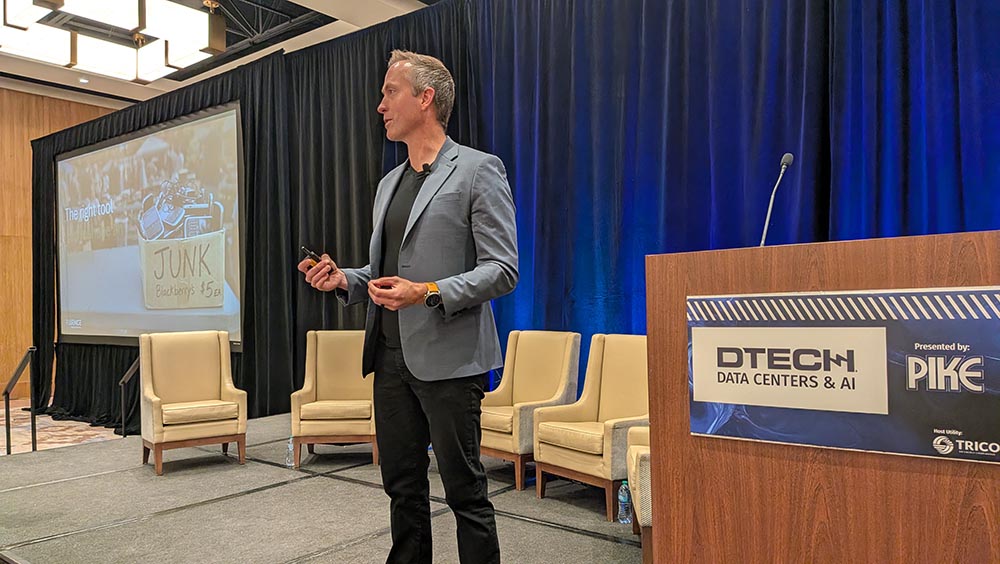
Jeff Monday, chief growth officer at Fluence, outlined strategies and technologies that could provide those answers during his keynote address. He detailed how battery storage can now be thought of as infrastructure, not as experimentation, but as actively stabilizing the present-day grid so that data center developers can avoid getting stuck in the interconnection queue. This new way of thinking about battery storage is one of the reasons that a Bring Your Own Power (BYOP) approach is becoming a solution for developers that need power right now, underscoring a need that is ultimately more about flexibility than capacity.
Monday outlined how leveraging battery storage in this manner can transform it into a foundational operating system of the AI economy, providing a blueprint for interconnection that delivers tangible value today and over the next two decades. We caught up with him after his session to further explore the short and long-term ramifications of this way of thinking, which will continue to define discussions for both utilities and developers.
Jeremiah Karpowicz: Do you envision BYOP strategies as a temporary workaround for slow interconnection, or is it the first step toward large loads becoming autonomous microgrids?
Jeff Monday: It’s neither, and that framing actually misses what’s happening.
BYOP isn’t a workaround — it’s how large loads are going to interconnect for the foreseeable future, because the underlying problem isn’t slow utilities. It’s that interconnection queues run five-plus years, and AI data centers need power in one to two. That gap doesn’t close just by speeding up paperwork.
But “autonomous microgrid” undersells it too. The most interesting BYOP configurations aren’t islanding from the grid — they’re using storage to become a better grid citizen than a conventional load. Storage lets a data center smooth its own ramps, shape its own profile, and show up to the interconnection point as predictable, controllable demand. That’s the opposite of autonomy. That’s partnership at machine speed.
What we’re really watching is the emergence of a new interconnection model — one where generation, storage, and load get planned together from day one. SPP’s HILLGA process is the early proof point: a 90-day path for large loads paired with on-site generation, versus a multi-year standard timeline. ERCOT is getting to the same place from the opposite direction with mandatory curtailment under SB 6. Different philosophies, same commercial outcome — paired storage and generation become the price of admission.
Jeremiah: What does it mean for energy storage to function as a system rather than just a battery?
Jeff: When customers come to us, they’re not asking for a battery. They’re asking for certainty — that their projects will pencil out, that their systems will perform, that the grid will be ready for what’s next. A battery is a component. A system is what delivers that certainty.
Practically, that means three things working together. The hardware has to be safe, bankable, and built to last 20 years. The software — the controls layer — has to do the actual work of shaping load, controlling ramps, and coordinating with the grid in milliseconds. And the services wrap has to keep performance guaranteed across that 20-year life as use cases evolve. Take any one of those away, and you’ve sold someone a box, not an asset.
The system framing also matters because the value proposition changes over time. Today, a battery storage system at a data center might primarily be solving power quality and bridging interconnection. In five to seven years, as the compute hardware itself becomes more power-efficient and predictable, the on-site use case evolves. You don’t want what you bought to become a stranded asset. A system — with the right controls and market access — can pivot into a tradable grid asset that improves long-term ROI. A battery can’t do that, but a system can.

Jeremiah: How can storage-integrated architecture bridge the 18-month chip cycle and the multi-decade grid?
Jeff: This is one of the most underappreciated questions in the industry, and it’s exactly why I describe storage as the architectural layer the grid has been missing. AI chips evolve every 18 months, while substations are built over a decade. These two timelines were never going to sync, and storage is the architectural layer that allows them to coexist.
Storage absorbs the mismatch. It responds in milliseconds to whatever the chips are doing today, and it does that without forcing the utility to re-engineer its multi-decade infrastructure plan around the latest GPU. That’s the bridge: storage is the only asset on the grid that operates at the speed of compute and the lifecycle of infrastructure simultaneously.
And here’s the part most people miss — the same flexibility that bridges that gap also future-proofs against it. As chip-level power management improves, the storage asset doesn’t become obsolete. It just changes jobs. From power buffer, to grid services provider, to merchant trading asset. The grid lasts decades because the architecture is flexible. The chips evolve every 18 months because the architecture is flexible. Storage enables that flexibility in both directions.
Jeremiah: What’s the biggest challenge around turning grid liabilities into flexibility assets? Is it about the technology itself? Or the approach to doing so? Or the way in which the utility or developer might be thinking about these assets?
Jeff: It’s mindset. The technology is here, and the approach is being proven out in real time — SPP, DOE-to-FERC, ERCOT, hyperscaler procurement teams, all moving fast. None of that is the bottleneck.
The real hurdle is evolving how we fundamentally categorize these assets. Too many still think of data centers as problems to be managed and storage as a renewable accessory. Both are wrong, and both are stuck in a previous era.
Data centers aren’t grid shocks — they’re dynamic loads with highly variable operating profiles, and that’s a description, not a complaint. Storage isn’t a complementary technology — it’s a flexibility asset that makes every other generation source, thermal or renewable, work better.
Jeremiah: What’s one thing you want people to know about how your opening not only helped define conversations at the event, but has already helped shape them beyond it?
Jeff: The single thing I want people to know is that storage has crossed a threshold. It’s not supporting infrastructure anymore. It’s becoming the operating system of the AI economy — and once you see it that way, every conversation downstream changes.
If storage is the OS, then BYOP isn’t a workaround; it’s an architecture. Interconnection isn’t a queue problem; it’s a flexibility problem. Data centers aren’t loads to be feared; they’re sites to be engineered. The “batteries vs. gas” debate becomes obviously the wrong question. The question becomes how fast we can build systems where every asset — thermal, renewable, storage, load — operates more reliably because of what’s around it.
That’s the frame I wanted to set for the rest of the event and for every conversation our industry has over the next two years. The question isn’t whether storage becomes core infrastructure. It’s how fast we get there together.
Sumber Artikel:
Renewableenergyworld.com