
How can energy infrastructure possibly meet the electricity demand of data centers?
That open-ended thought experiment is taking center stage at the 2026 IEEE PES T&D Conference & Exposition. As artificial intelligence (AI), cloud computing, and the digital economy drive unprecedented growth in energy demand, the grid will need to expand and evolve in ways that require stakeholders on all sides to rethink traditional frameworks and embrace a different approach to solving inherently complex energy challenges.
But what does doing so actually look for utilities, developers, and regulators?
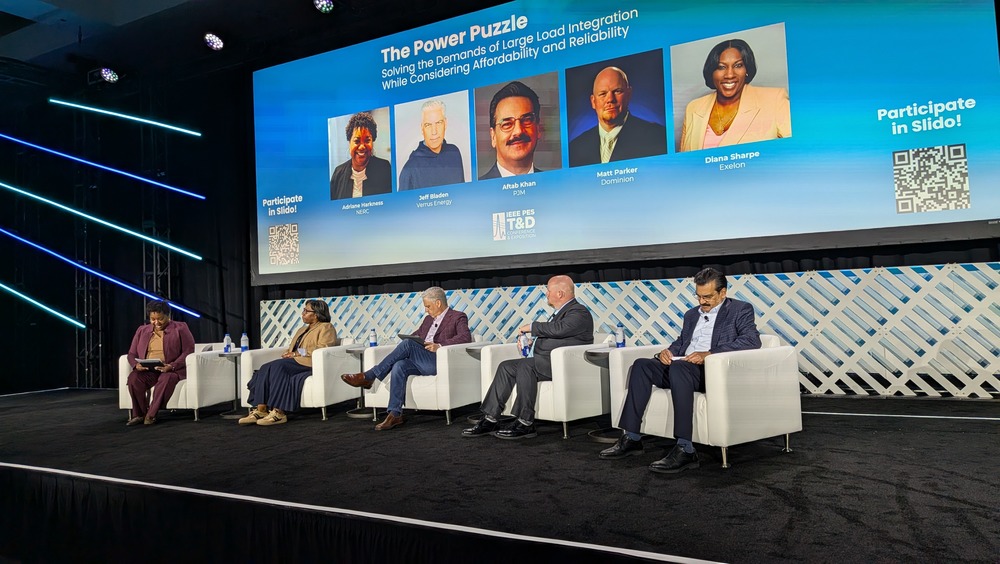
During the event’s keynote panel, experts from Verrus Energy, PJM Interconnection, Dominion, and Exelon highlighted flexibility as a critical strategy. Their discussion underscored that not all large-scale loads are created equal and highlighted how customers who can adjust demand in real-time can provide utilities with the options they need. Those are the sorts of options that can be fully defined when the utility and the developer approach these projects differently.
“What you need is a change in perspective at the beginning of the conversation,” said Jeff Bladen, head of energy at Verrus Energy. “Developers need to look to utilities not just as power providers, but as long-term infrastructure partners. Rather than just asking about how much power is available, they need to think of themselves as customers that a utility is going to want to work with.”
This shift in perspective can be transformative, helping create realistic timelines and an interconnection process that serves both short-term needs and long-term grid stability. By aligning interests early on, both parties can move away from traditional friction and toward a more functional partnership.
Thinking of one another as partners is something that Diana Sharp, vice president of national accounts and customer solutions at Exelon, further explored. She talked about how a mismatch in expectations can cause these relationships to start off on the wrong foot, and how the early conversations become more focused on supporting one another as partners. Doing so can help to establish mutual understanding and trust at the very beginning.
“Developers will often ask: ‘Where can we go and how much power can we get?’” she told the crowd. “But I want to turn that around and ask them: ‘Where do you want to go and how much power do you need?’ So it’s essential to not talk past one another in those early stages.”
Collaboration from the perspective of being a good partner creates a foundation to more effectively integrate massive new electric loads without compromising affordability or reliability. It also reinforces a central theme of the session that Bladen showcased during the panel and after.
“Flexibility is the bridge between the grid we have and the grid we need,” Bladen said and later d.

How are Other Stakeholders Approaching Data Centers?
On the data center stage, a separate panel of experts examined how RTOs and international stakeholders are addressing these challenges. While the core obstacles are universal, the strategies for solving them vary significantly based on regional priorities, local grid constraints, and the realities of the grid in a given region, country, or continent.
Damir Novosel of Dash Power Partners highlighted tension between economic expansion and infrastructure costs. He noted that while rising load growth is a positive indicator that spurs interest and support, it also requires massive capital investment that directly threatens affordability, a major focus.
“Load growth is great,” Novosel said. “But with that, you’d expect more investment that can impact affordability, and that’s the tricky part.”
Sorting out where the investment will come from is a central challenge for modern utilities. Many data center developers explore the same type of agreement with multiple utilities, making an assessment of “what’s real” difficult on multiple levels. To mitigate this, some utilities, including Entergy Louisiana, have come to direct agreements that are designed to deliver billions in customer savings. At the RTO level, PJM is focused on how to manage the procurement of 15 gigatwatts (GW) of energy and ensuring that those who want to connect are the ones who pay for the infrastructure.
It’s not just PJM that is dealing with interconnection issues, though. The sheer volume of projects hoping to connect to the grid is staggering. Mark Carpenter from Oncor noted that his utility has submitted 122 GW for the next five years, with another 151 GW of capacity waiting behind that. For context, the all-time record load for the entire ERCOT system is 85 GW. It’s not just about the load, though, as location is also a challenge since many developers want to be in the same physical area. These factors have forced a total reimagining of how the organization integrates and serves demand.
“ERCOT is in the process of throwing away [its] traditional planning approach,” Carpenter d. “The increase in demand is great, but it doesn’t work with the way things have been done.”
These challenges are similar but distinct across the globe. Marco Simiano from GE Vernova noted that data centers in Europe are generally smaller than their counterparts in the United States, but they often face higher complexity due to segmented regulations and a more rigorous commitment to decarbonization. Despite these regional distinctions, challenges related to grid capacity and infrastructure are quite similar.
“The regulatory bottlenecks are further compounded by two other major hurdles,” Simiano told the audience. “One is aging infrastructure, and reports say that 90% of what’s out there now will need to be modernized in the next decade. We’re also dealing with an aging workforce, with as much as 50% of the industry needing to be hired in the next few years.”
In discussing what it means to move past these challenges, these panels and numerous others at the event explored a broader shift that will fundamentally change how energy loads are interconnected. If data centers can operate as behind-the-meter solutions in the short term, they could provide much-needed flexibility to the grid in the long term, but doing so requires actively communicating how data centers can positively address affordability concerns and benefit the surrounding community.
This opportunity connects with the present and future of the entire utility industry, as panelists noted that they have yet to see any hyperscale data center close. It’s why stakeholders on all sides should view the installation of a data center as a long-term asset that requires a shift from traditional interconnection strategies to a more flexible model.
Data center construction and the advent of artificial intelligence (AI) are driving unprecedented electric load growth across the United States. Massive hyperscalers with deep pockets and bold aspirations need power, and they need it fast.
From May 12-14, 2026, DTECH Data Centers & AI will assemble utilities, engineers, and technical decision-makers from across this emerging ecosphere in Scottsdale, Arizona, to discuss everything from capacity constraints to streamlining studies, from modernizing infrastructure to integrating onsite generation into both utility and customer-side systems.
Register for DTECH Data Centers & AI now!
Sumber Artikel:
Renewableenergyworld.com