Featured in this article

Best Portable Power Station Overall
Bluetti Elite 300
Amazon

Best Power Station for Camping
Jackery Explorer 1500 Ultra
Amazon

Best Power Station for Overlanding
GoalZero Yeti 1500 (2026)
Goal Zero

Best Small Power Station
Anker Solix C1000
Anker
The gadgets and appliances that make modern living so comfortable have one thing in common: They all need power. Portable power stations have enjoyed a meteoric rise over the past few years, as people have turned away from gas-guzzling generators. Whether you’re camping for the weekend, living off-grid, or protecting against power outages, these big batteries can help.
There’s no such thing as the best power station for most people, because it depends on what you need, but I have spent years testing several to find which models work for certain situations. I have tried systems that can provide from 768 watt-hours to 6.4 kilowatt-hours of backup power. I’ve also added important advice on what to consider when shopping for one. For more modest needs, read our Best Power Banks guide.
Updated May 2026: I’ve added new top recommendations from Bluetti, Jackery, and Goal Zero; reorganized some of our picks; added a mention for Vtoman; included advice on caring for power stations and information on what I do with review units after testing; and updated prices.
-
Best Portable Power Station Overall
Chevron Chevron to wishlist Bluetti
Elite 300
Amazon
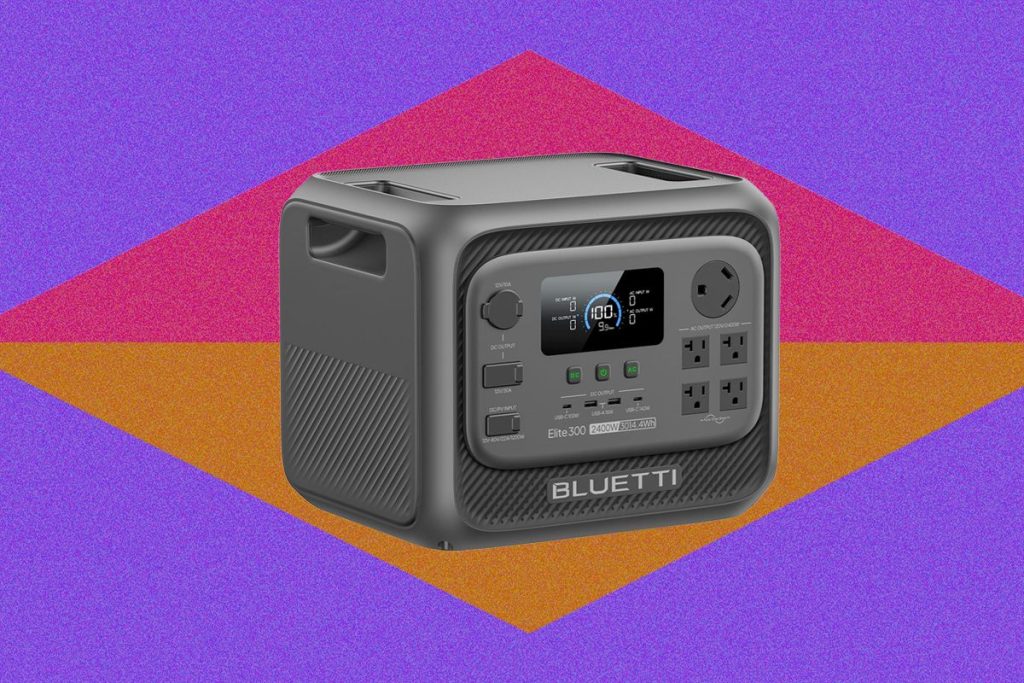
Bluetti’s Elite 300 is so compact that I had to double-check its 3,014-watt-hour capacity, as it’s about the same size as most 2,000-watt-hour power stations. I don’t know how Bluetti packed such large lithium-iron phosphate (LiFePO4) batteries inside, but this could be a great power station for an RV where space is limited. It’s also suitable for home backup power or campers. There are ports aplenty, and this power station can charge phones or laptops and happily run a fridge or TV. Performance was flawless with smaller gadgets (the USB-C ports fast-charged all the phones I tested) and less demanding appliances, coming close to the stated capacity (consistently around 85 percent). It passed my UK kettle test (when it exceeded the 2,400-watt maximum output, surge mode kicks in, giving you a couple of minutes at up to 4,800 watts), but boiling a full kettle drained 7 percent of the battery. Even under a heavy load, the Elite 300 fans are quiet. They never exceeded 50 decibels and hushed quickly when the load dropped below 2,400 watts. The Bluetti Elite 300 can also serve as an uninterruptible power supply with a 10-millisecond delay.
It has built-in handles, but at just under 58 pounds, the Bluetti Elite 300 is capable of giving you a bad back. Most power stations this size have wheels, and you could easily strain yourself when moving it if you’re not careful. Sadly, it’s not expandable—go for the AC200L instead if that’s important to you. Recharge times are good. With AC charging, the Elite 300 can pull 2,300 watts to hit 80 percent in an hour and a half and can fully charge in just over two hours. Standard charging is better for the battery and takes around three hours. You can also charge via portable solar panels (up to 1,200 watts) or a car (cables provided), though it’s much slower. There’s 2.4-GHz Wi-Fi support, connectable through the app to enable remote control and monitoring. Some ports have soft silicone covers. The stacked block of four AC sockets may mean that some power adapters block other sockets, though the UK version I tested has only two. You get a five-year warranty with this power station.
If you don’t need this much power, the Bluetti Elite 200 V2 ($999) and the Bluetti Elite 100 V2 ($569) are also excellent.
Specs Capacity: 3,014 watt-hours Max Output: 2,400 watts (4,800-W surge) AC Charging time: 1.6 hours Ports: 4 x AC (2 x AC in UK version), 1 x Car, 2 x USB-A (15W), 2 x USB-C (100 W and 140 W), 1 x Barrel Port (360 W) -
Best Power Station for Camping
Chevron Chevron to wishlist Jackery
Explorer 1500 Ultra
Amazon
If you want to take power with you on outdoor adventures, the Jackery Explorer 1500 Ultra is ideal for a long weekend in the wilderness. It is IP65-rated, so you don’t need to worry about rain or dust, and it’s shock-proof, so it can survive an accidental drop (up to one meter). I love the comfy handle, which makes it easy to carry from the car to your campsite one-handed, along with other stuff (most power stations this size have two handles). It weighs just shy of 40 pounds. The LiFePO4 batteries inside give you a decent power output of 1,536 watt-hours, and it’s relatively compact for this capacity. As usual with Jackery, the build quality is solid, but the rubbery port covers (required for that IP rating) can be a bit fiddly.
The Explorer 1500 Ultra did well in my tests, coming very close to the stated capacity, and it will charge all your small gadgets easily and power small appliances or power tools. The cooling fan in the base seems pretty effective, and it never broke 30 decibels for fan noise. It can put out 1,800 watts steadily, jump to 2,000 watts for up to 15 minutes, and handle 3,600 watts for very short bursts. It recharges from an outlet in 90 minutes, and you can use solar or car charging, which takes around 3 hours. You get a five-year warranty with this power station.
Specs Capacity: 1,536 watt-hours Max Output: 1,800 watts (3,600-W surge) AC Charging time: 1.5 hours Ports: 3 x AC, 1 x Car, 1 x USB-A (18 W), 2 x USB-C (100 W and 30 W)


-
Best Power Station for Overlanding
-
Photograph: Scott Gilbertson
-

Photograph: Scott Gilbertson
-

Photograph: Scott Gilbertson
Chevron Chevron to wishlist GoalZero
Yeti 1500 (2026)
Goal Zero
REI
The main appeal of power stations is that they’re all-in-one, ready-to-go energy systems. You don’t need to worry about hooking up inverters or monitoring systems; it’s all there. The downside of power stations is that most are less robust than DIY solutions, which is particularly important when overlanding or doing any off-road travel. Vibration is hard on plastic, and I’ve had several power stations eventually break down after a few years on the road. Plastic cracks, uncovered ports get clogged with dust; I’ve even had soldered connections come apart inside sealed batteries (thanks, washboard road into Chaco Canyon).
Goal Zero’s new Yeti 1500 power station is one of the best-built power stations I’ve tested. Unnearly everything else, the containing box is primarily metal (aluminum). Additionally, it was specifically designed to survive high-vibration environments, living in your van or off-road vehicle. There are still some plastic vent screens, but overall it’s very tough and has stood up well to life in a vehicle. While I haven’t taken it on the road into Chaco Canyon yet, it did spend two weeks in the back of my truck bouncing around dirt roads in New Mexico and Arizona, and it is no worse for the wear.
This is technically the sixth version of the Yeti 1500 and the first to use LiFePO4 battery chemistry, which is by far the biggest improvement over previous models (Goal Zero claims 4,000 charge cycles to 80 percent for the Yeti 1500). The Yeti 1500 offers a good selection of ports, split into three sections: AC power outlets, USB power outlets, and 12-volt power outlets. The AC section gives you four plugs with a max continuous power of 2,000 watts and surge capacity of 3,600 watts. This was plenty to run a residential fridge during a power outage. The USB options include a 140-watt charging port, a 60-watt port, two 30-watt ports, and two 18-watt USB-A ports. I charged everything from a brand-new Dell laptop to some camera batteries. I even charged an ancient iPod without issue. All those ports are fairly standard for a power station in this class and similar to what was on the previous model, although the 140-watt USB port is new and very nice to have.
Where the new Yeti 1500 shines is its 12-volt charging options, which include a high-power 12V port capable of 30-amp output. That’s much better than most of the batteries on this page, which max out at 10 amps. The 30-amp output is enough for most van and overlanding vehicle power systems, so you can tie the Yeti 1500 directly to a 12-volt distribution panel, which is why this is our pick for overlanding.
There are two things I don’t about the Yeti. One is that there’s no built-in heater. It’ll work just fine below freezing, but you can’t charge it (a cheap heating pad can often overcome this, depending on your setup). The other downside is that the price per watt hour is on the high side, but considering the 30 Amp output, I think it’s worth it if you want an all-in-one solution.—Scott Gilbertson
Specs Capacity: 1,505 watt-hours Max Output: 2,000 watts (3,600-W surge) AC Charging time: 1.1 hours Ports: 4 x AC, 1 x Car, 2 x USB-A (18 W), 4 x USB-C (140 W, 60 W, 30 W), 2 x 12-V 6 mm, 1 x HPP -
-
Best Small Power Station
-
Photograph: Simon Hill
-

Photograph: Simon Hill
-

Photograph: Simon Hill
Chevron Chevron to wishlist Anker
Solix C1000
Anker
Amazon
Amazon (Gen 2)
As a big fan of Anker’s power banks, I was excited when the company launched a line of portable power stations, and the Solix C1000 did not disappoint. This LiFePO4 battery promises a decade of use and packs a 1,056-watt-hour capacity, which you can double with a BP1000 Expansion Battery ($799). The charcoal-and-gray design with blue highlights and a silver power button looks classy. Built-in handles make it fairly easy to carry (it weighs just shy of 30 pounds). The limited capacity and maximum output make this suitable for topping off small gadgets, but it had no trouble powering a small fridge, TV, and power drill. I also tested with a hair dryer, and the surge handled it. The Solix C1000 consistently performed well in my tests, was capable of fast-charging most phones, and worked well as an uninterruptible power supply with a 20-millisecond delay. The LED bar on the front has three brightness levels, which is very handy for a campsite.
While you can refill the Solix C1000 from wall power in just under an hour if you toggle “UltraFast Charging” in the app, it’s an emergency measure, and Anker recommends charging more slowly for battery health. There’s an XT60 input for solar panels or charging from a car socket (cables included). While it’s generally a quiet operator, the fan can get loud under a heavy load (I measured around 70 decibels at its peak), though it quietens swiftly when the load drops back below 1,800 watts. The only other issue I had was that one of the USB-C ports kept overloading and switching itself off when charging an Oppo phone. Anker offers a five-year warranty with the Solix C1000.
I also tested the more compact Anker Solix C1000 Gen 2, which is a little faster to charge (49 minutes), boasts two 140-watt USB-C ports, and can output 2,000 watts steadily (3,000W peak). It also has a fancier display and swifter UPS response (10 milliseconds). On the downside, it has a slightly lower 1,024-Wh capacity, is not compatible with the expansion battery, and loses the light bar. If you’re not too bothered about the differences, I’d go with whichever is cheaper.
Specs: Gen 1 Gen 2 Capacity: 1,056 watt-hours 1,024 watt-hours Max Output: 1,800 watts (2,400-W surge) 2,000 watts (3,000-W surge) AC Charging time: 1 hour 50 minutes Ports: 6 x AC (4 x AC in the UK), 1 x Car, 2 x USB-A (12 W), 2 x USB-C (100 W and 30 W) 5 x AC (4 x AC in the UK), 1 x Car, 1 x USB-A (20 W), 3 x USB-C (140 W and 20 W) -
-
Best Smaller-Capacity Power Station

Photograph: Simon Hill
to wishlist Ecoflow
River 2 Pro
Amazon
Walmart
REI
By far the most portable power station in our guide, the EcoFlow River 2 Pro weighs just 17 pounds and has a large handle along the back. The LiFeP04 battery inside is good for 768 watt-hours, and I managed to squeeze a little more out of it in my tests. The ports are great for camping trips, with everything you need to charge small gadgets. Using the X-Boost surge, you can power small appliances, but I wouldn’t risk a hair dryer or a UK kettle. The River 2 Pro can also function as an EPS with a 30-millisecond delay. The EcoFlow app is slick, and you can connect via Bluetooth or Wi-Fi, but you don’t really need it.
The River 2 Pro takes over an hour to charge from wall power and has a standard XT60 connector for solar panels, but the fan can get noisy. It doesn’t always kick in when charging smaller gadgets, but with more demanding things plugged in or when you recharge it, the River 2 Pro makes a bit of a racket (my Apple Watch says as high as 57 decibels). Thankfully, EcoFlow offers a 5-year warranty, and it’s certified for safety by TÜV Rheinland (an independent testing service).
Specs Capacity: 768 watt-hours Max Output: 800 watts (1,600-W surge) AC Charging time: 70 minutes Ports: 3 x AC, 1 x Car, 2 x DC5521, 3 x USB-A (12 W), 1 x USB-C (100 W) -
Best Tiny Power Station
-SOURCE-Simon-Hill.jpg)
Photograph: Simon Hill
to wishlist Jackery
Explorer 300 Plus
B&H
Amazon
Folks seeking more power for camping or a long road trip should pick up the Jackery Explorer 300 Plus. This cute and compact battery has a fold-out handle, packs a 288-Wh capacity, and weighs 8.3 pounds. It has two USB-C ports (18W and 100W), one USB-A (15W), a car port (120W), and an AC outlet (300W, 600W surge). There is plenty of power to keep your small gadgets going for a few days. There’s also an AC input, or you can charge it via USB-C. The fan kicks in sometimes, but the Silent Charging Mode keeps it below 45 decibels. You can manage it with Jackery’s app via Bluetooth, and it also has a handy flashlight.
We have found Jackery gear reliable and durable, and you can expect to get at least a decade out of this battery. Go any bigger than this and portability gets debatable. If you want charging options for going off-grid, you can get the 300 Plus with a 40W book-sized solar panel. It took me around eight hours to charge the battery with this panel in clear sunshine.
Specs Capacity: 288 watt-hours Max Output: 300 watts AC Charging time: 2 hours Ports: 2 x USB-C, 1 x USB-A, 1 x Car socket, 1 x AC
-
Best for Drone Pilots
-

Photograph: Simon Hill
-

Photograph: Simon Hill
-

Photograph: Simon Hill
-

Photograph: Simon Hill
Chevron Chevron to wishlist DJI
Power 2000
Amazon
Walmart
It makes sense that the maker of some of the best drones would create a portable power station to help you keep them powered up. After all, flight time is often very limited due to battery sizes, and if you have a power station right there, you can get back in the air faster. The DJI Power 2000 has a typical design with molded handles, though it weighs around 49 pounds. A trio of features makes the DJI Power 2000 stand out. First, it can output 3,000 watts steadily (3,600 watts surge); second, it has two USB-C PD 3.1 ports that can put out 140 watts; and finally, it has two of DJI’s proprietary Software Defined Charger (SDC) ports for fast-charging drone batteries. It had no trouble powering a microwave and hair dryer, fast-charging phones, and my MacBook, but it is built for speedily charging DJI drones.
The fan took a while to kick in and can get noisy, hitting 45 decibels with gadgets plugged in, but it stays quiet when charging from an outlet at around 25 decibels, so you can easily sleep in the same room while it charges. It took me around 75 minutes to fully charge from an outlet. The DJI Home app enables you to connect, tweak settings, and remotely control the power station. You can connect up to 10 expansion batteries to create a home backup, and the UPS mode kicks in after 10 milliseconds.
If you don’t need this much power or want something more portable, the DJI Power 1000 V2 ($429) is also excellent. I love DJI’s range of handy accessories; the carrying bag ($99) and shoulder strap make the 1000 way easier to lug around. Speaking of extras, you need an adapter module ($59) to charge from solar panels ($209), a special cable ($49) to plug into your car, and fast-charging cables for your drones (around $20 apiece). You can also get an expansion battery, connecting cable, and hand truck combo ($798) for the 2000.
Specs Capacity: 2,048 watt-hours Max Output: 3,000 watts (3,600-W surge) AC Charging time: 1 hour 15 minutes Ports: 4 x AC, 4 x USB-A (24 W), 4 x USB-C (140 W and 65 W), 2 x SDC -
-
Best for Hiking

Photograph: Simon Hill
to wishlist Bluetti
Handsfree 1 Portable Power Backpack
Amazon
Bluetti
The more power you pack into a portable charger, the less portable it becomes. Bluetti’s solution is a custom-designed 42-liter backpack with a slim 268.8-WH solar generator that slides into a slot in the back. There are plenty of ports to keep your gadgets topped off; there’s even an AC socket and enough power for a couple of days of hiking. If you pair it with solar panels, you can go off-grid indefinitely. The pack is bulky and weighs 11 pounds (5 kg) before you load your stuff in; it can carry up to 66 pounds (30 kg). The designers took an everything-but-the-kitchen-sink approach, so it has adjustable velcro foam dividers, Molle straps, and zippered pockets galore. It’s ideal for trips with photography gear or drones. The two side panels zip open to enable you to access the ports easily, and there’s an LED display to show remaining power and watts in and out, though it can be tough to read in direct sunlight.
The Bluetti Handsfree 1 comes with a 4.9-foot AC charging cable and a 4.9-foot MC4-XT60 solar charging cable. It took me over an hour and a half to fully charge from an outlet. If you go for the optional 60-watt solar panel array, it will take around six hours, depending on the weather. But the cool thing about that is you can unfurl the solar panels and attach them to hang down your back to charge while you hike. On the downside, I had to lean forward with this fully loaded, and it’s only splash-proof, though Bluetti includes a rain cover. If you need more power, the 60-liter Bluetti Handsfree 2 ($399) has a 512-WH battery.
Specs Capacity: 268.8 watt-hours Max Output: 300 watts AC Charging time: 1 hour 30 minutes Ports: 2 x USB-C, 2 x USB-A, 1 x Car socket, 1 x AC
-
Best for Cold Weather
-

Photograph: Simon Hill
-

Photograph: Simon Hill
-

Photograph: Simon Hill
-

Photograph: Simon Hill
Chevron Chevron to wishlist Bluetti
Pioneer Na
Bluetti
Cold is the enemy of batteries, causing them to run out of power faster and charge more slowly. Bluetti tackles that issue with the sodium-ion battery-toting Pioneer Na range. Sodium-ion batteries perform better than traditional lithium batteries in low temperatures, and Bluetti says the Pioneer Na can still be charged at 5 degrees Fahrenheit or -15 Celsius and continue to provide power at down to -13 degrees Fahrenheit or -25 Celsius. The trade-off here is that the Na is relatively big and heavy (35 pounds) for its 900-Wh capacity. I love the blue finish, and the handles on either side make it easy-ish to carry. You also get loads of ports, a clear LCD screen, and a 15-watt wireless charging pad on top for your phone. It had no trouble in my tests and managed to power an electric heater for just over half an hour.
Unless you are camping in the cold, ice fishing, or somewhere you really need the low-temperature performance, you can get more for your money with other options on our list. That said, another potential pro for sodium-ion is that it doesn’t require lithium or often unethically mined and toxic cobalt, so it is better for the planet. Bluetti suggests a 10-year lifespan or 4,000 cycles, but only offers a two-year warranty with this power station.
Specs Capacity: 900 watt-hours Max Output: 1,500 watts (2,250-W surge) AC Charging time: 1 hour Ports: 4 x AC (2 x AC in the UK), 1 x Car, 4 x USB-A (15 W), 1 x USB-C (100 W), 1 x wireless charging pad (15 W) -
Other Portable Power Stations We Tested

Photograph: Simon Hill
Jackery Portable Power Station Explorer 2000 Plus for $1,999: The versatile, expandable, durable, and dependable Explorer 2000 Plus was my top pick for a while, and it’s still a good choice if you find it on sale, though the Bluetti Elite 300 that unseated it packs more power into a smaller form. It does still offer some advantages, chiefly that you can double or triple the 2,042-watt-hour capacity by adding battery packs. In my tests, the capacity consistently matched up with Jackery’s claims. It had no trouble with the kettle test (UK kettles hit 3,000 watts), though it chewed through 6 percent of the power. You can charge it speedily from the mains (AC outlet), but it also works as a solar generator. I filled it from 32 percent in a single scorching day with Jackery’s SolarSaga 200-watt solar panel. The fan is relatively quiet at around 30 decibels, but it comes on frequently. It weighs a whopping 62 pounds, and though there are indented handles on either side, a telescopic handle, and two wheels, it can still be tough to move around. The covers on the car port, inputs, and expansion port on the back are annoyingly tight. (I sometimes had to use a screwdriver to open them.) The Wi-Fi connection is 2.4 GHz only, and it took me a while to figure out that the connection mode requires you to press the AC and DC buttons together, since that doesn’t seem to be documented anywhere. Minor niggles aside, this is a great power station to serve as a home backup or off-grid generator. The warranty is three years, but you can extend it to five years by registering with Jackery.

Photograph: Simon Hill
Bluetti Elite 200 V2 for $999: While the Elite 300 is my new recommendation, if a 2,074-watt-hour capacity is enough for you, this power station has similarly strong build quality and mostly the same features (wattage is 2,600 and 3,900 at peak, and UPS has a 15-millisecond delay). It’s relatively fast to charge, can easily power your gadgets and small appliances, and has an info-packed display that’s legible outdoors.
BioLite BaseCharge 1500 for $1,360: Weighing 29 pounds, it has recessed handles at each side for carrying, though this is as big a power station as I can imagine lugging any real distance. There’s no superfluous app. You can do everything using the buttons and the display on the front. It has a good mix of ports to cover a lot of small gadgets phones, tablets, and laptops. There’s even a wireless charging pad on top. I wouldn’t run anything too demanding on it, but it coped fine with an electric drill and blender. I tested it with BioLite’s SolarPanel 100, but the BaseCharge 1500 has a standard High Power Port (HPP) input, so you don’t have to use BioLite’s solar panels. It finished just on either side of the stated capacity in my tests. Sadly, the BaseCharge 1500 takes a long time to charge. Even from a wall outlet, you need a day, though you can speed it slightly by using the PD USB-C as a second input. Solar charging from a single SolarPanel 100 takes several days. The battery is also a Li-NMC, so it ly won’t last as long as some of our other picks. The BaseCharge 1500 comes with a two-year warranty.
Ampace Andes 600 Pro for $449: This compact power station weighs 19 pounds and has an easy-carry handle on top. It stores 584 watt-hours of power and can be fully charged in an hour (30 dB sleep mode). It can deliver 600 watts (1,800 W surge), and has lots of ports (2 x AC, 2 x USB-C, 2 x USB-A, 2 x DC 5521, 1 x Car). There’s also a remote control app where you can change the light bar function or the colored light on top. It worked well in my tests and could be handy if you want something portable for small gadgets on a camping trip, but the EcoFlow River 2 Pro above gives you more power for less.

Photograph: Simon Hill
EcoFlow Delta 3 Plus for $699: I the stylish, compact design of EcoFlow’s Delta 3 Plus, with the screen and ports at one end. It offers 1,024 watt-hours, can consistently provide 1,800 watts, and has a 2,600-W surge mode. It can also charge up in an hour and has lots of ports (6 x AC, 1 x Car, 2 x USB-A, 2 x USB-C, 2 x DC5521). You can add capacity with EcoFlow’s impressively compact and stackable add-on battery ($599), though it is pricey. The Plus version includes two solar ports for faster solar charging and can pull UPS duty with an impressive 10-millisecond response time. The reason it misses out on a full recommendation is the fan. The fan turned on all the time, even when I was only charging a single phone, and continued at around 55 decibels after it was fully charged and unplugged. It got louder when I charged the Delta 3 Plus from a wall outlet. It could disturb you, and it gave me concerns about overheating. Fan noise aside, I d this power station, and the app also works well if you want to remote-control it. There is a quiet charging mode, but it drops the rate to 200 watts, meaning it will take more than five hours to fully charge.

Photograph: Simon Hill
Bluetti AC200L for $1,599: This was replaced by the Elite 200 V2 above, but it is still a decent power station with a similar feature set. It has slightly lower capacity, and it’s heavier and pricier right now, but it is expandable up to 8,192 watt-hours with Bluetti’s add-on batteries. The design and performance are similar, but the Elite 200 V2 edges it for me and is a better buy, especially if you can pick it up for less.
Dabbsson DBS1000 Pro Portable Power Station for $899: This 1024-watt-hour power station has a LiFePO4 battery and a decent mix of ports to charge and power your gadgetry. The US model has four AC outlets, three USB-A ports, three USB-C ports, a car socket, and two DC5521 barrel ports. It can charge to 80 percent in under an hour when plugged in, but expect some fan noise. You can also charge from solar panels or through the car port. You can connect via Wi-Fi and control it from the app, but the display still gives you the info you need without it, and it has a customizable light underneath. The 2,000-watt output is impressive, and there are boost and surge modes to briefly take it to 3,000 and 4,000 watts, respectively. It performed well in my tests and can act as an EPS with a 15-millisecond delay. It’s a solid alternative to our picks above, but doesn’t stand out. The fan comes on frequently and can be annoying. I also had an issue with one of the USB ports sometimes refusing to charge a phone. Buy the DBS2000B battery expansion to boost capacity to 3,072 watt-hours and increase output to 2,400 watts. It comes with a five-year warranty with registration.
Bluetti AC180 for $499: This small Bluetti power station is a solid option if you don’t need as much juice. The AC180 also has a LiFePO4 battery inside, but with a 1,152-watt-hour capacity. It maxes out at 1,800 watts but can surge up to 2,700 watts for short bursts. The US model has four AC outlets, one USB-C (100 W), and four USB-A ports (15 W apiece). There’s even a wireless charging spot on top that goes up to 15 watts. You can fully charge the AC180 from an outlet in an hour, and it comes with solar and car charging cables as alternatives. It can also act as a UPS with a 20-millisecond switching time. This power station is good for small gadgets and appliances a TV or a mini fridge. Fan noise hit around 45 decibels under a heavy load, which isn’t too bad. What I don’t is the weight (35 pounds seems relatively heavy for this capacity), and I’d prefer more USB-C ports.
Zendure SuperBase Pro 2000 for $1,000: With a whopping 2,096-watt-hour capacity, tons of outlets (6 x AC, 1 x Car, 3 x DC5521, 4 x USB-C), and a maximum output of 2,000 watts (surge 3,000 watts), this is a great portable power station. It is 47 pounds but has two wheels, a carry handle, and a separate telescopic handle. Zendure’s app is slick; this power station can serve as an uninterruptible power supply and performed well in my tests, though the fans were almost constantly on. I also have concerns about its longevity. The SuperBase Pro 2000 has a Li-NMC battery inside, probably because it offers greater energy density than LiFePO4 (the similarly sized SuperBase Pro 1500 has a LiFePO4 battery and just 1440-watt-hour capacity), but Li-NMC batteries don’t last as long. The warranty is 2 years, but you can extend it by a year by registering with Zendure.
Don’t Bother

Photograph: Simon Hill
Acer 600W Portable Power Station: This power station is certainly portable, with a LiFePO4 battery offering 512 watt-hours via nine ports (two AC, two USB-A, two USB-C, two DC5521, and a car port). It’s a decent size for a campsite and suitable for lighting and charging portable gadgets, but with a maximum output of 600 watts, I wouldn’t plug in anything too demanding. You can fully charge it from a wall outlet in around two hours. There’s a small LCD for remaining battery percentage, estimated remaining run time at current usage rates, and wattage input and output. It worked fine in my tests, but it seems to be available only in the UK and is pricey for the capacity.
Vtoman FlashSpeed Pro 3600: Huge and heavy for its capacity (3,096 watt-hours), this power station has wheels and a telescopic handle to enable you to move it around without injury. The first unit I tested was faulty, so Vtoman supplied me with a replacement. While it worked far better, I can’t recommend this power station. The Bluetti Elite 300 above is cheaper, far more compact, and will suit most folks better, though the Vtoman has a clear advantage in potential output (it can sustain 3,600 watts and peak at over 7,000 watts for short bursts). Unfortunately, I hate the plastic front panel that you must lift to access the ports; the display is too dim to read outdoors; the build quality is suspect (it’s all a bit creaky); and it’s way, way too big.
Power Stations: Frequently Asked Questions
How Expensive Are Portable Power Stations?
Portable power stations can be very expensive, but discounts, sales, and deals are common. If you can afford to wait, you can ly get your chosen power station for less than the listed MSRP.
What Capacity Do I Need?
Figure out how much power you need. The capacity is listed in watt-hours (Wh) or sometimes kilowatt-hours (kWh). If you think about the devices you want to run and how long you need to run them, you can start to calculate the capacity you need. Manufacturers will often display stuff 12 hours of TV or 30 minutes of electric chainsaw use, but not all TVs draw the same amount of power. You must calculate how much the gadgets you own actually use.
How Portable Are Portable Power Stations?
The term “portable” is sometimes stretched. Batteries are heavy. The larger-capacity power stations are typically on wheels and have telescopic handles, and they are still tough to cart around. If you’re looking for something you can actually carry on foot for a distance, you may need to temper your expectations on capacity.
What Can You Run on a Portable Power Station?
All portable power stations can charge up small gadgets phones and laptops or be used to power lighting. Most can handle small appliances mini-fridges or TVs. If you want to use power tools, an AC unit, or, in the UK, a kettle, you need to be able to draw thousands of watts. Power stations all state the maximum output, but they often have a surge function that enables them to go higher for a short period. Sometimes, they give it a silly name. For example, Zendure calls this “AmpUp,” and EcoFlow calls it “X-Boost.” Make sure your chosen power station can handle the wattage you need.
How Do I Charge a Portable Power Station?
All portable power stations can be charged from a wall outlet and should come with a charging cable. Some power stations can also be charged via a car port from your vehicle or a solar port from solar panels. Make sure you check that the ports you want are available and necessary cables are included.
How Long Does a Portable Power Station Take to Charge?
Large-capacity power stations can take a long time to recharge. Be sure you understand how quickly your chosen power station can charge from wall power and other sources if you plan to use solar panels, a vehicle battery, or another power source for top-ups. Some power stations enable you to fast-charge from two or more inputs.
What Ports Should I Look for in a Portable Power Station?
While you will find certain ports across the board with portable power stations, from AC outlets to USB-A, it is crucial to check the maximum charging rate and supported charging standards to avoid disappointment. You might find USB-C ports, car ports, barrel connectors, and maybe solar panel inputs, but assume nothing. Check the specs before you buy.
How Many Years Do Portable Power Stations Last?
Power stations typically last between three and 10 years, but can last longer, depending on how they are used and maintained. It’s important not to let them completely discharge too often or leave them empty for extended periods. Usually, the manufacturer will provide an estimate of how many charge cycles you can expect before performance starts to degrade. Warranties typically range from two to five years, but make sure you retain the guarantee and proof of purchase.
What Battery Types Are Commonly Used in Portable Power Stations?
There are various battery technologies, but the main ones used in portable power stations today are types of lithium-ion (Li-ion) batteries, often lithium nickel manganese cobalt oxide (Li-NMC) or lithium iron phosphate (LiFePO4 or LFP). The latter is safer (less prone to combustion) and tends to last longer (more cycles) before it starts to degrade. Overheating can be an issue for Li-NMC batteries, and they degrade faster but have a higher energy density. Zendure also offers semi-solid-state batteries in its top-of-the-line SuperBase listed above, which it promises are more stable and resilient, therefore safer, and have a higher energy density.
Can You Use a Portable Power Station as a UPS?
Some power stations can act as an uninterruptible power supply (UPS); others are classed as an emergency power supply (EPS). If you have your power station plugged into wall power and then devices plugged into it, they will work from wall power, but if there is a power outage, a UPS will switch to battery power instantly (around 10 milliseconds). An EPS will also switch when there’s a blackout, but may take a bit longer (30 milliseconds or so).
What Is the Difference Between a Power Bank and a Portable Power Station?
Size is the main difference between the power banks and the portable power stations. Power banks are typically compact with small capacities designed to charge smartphones and other small gadgets. Power stations have far larger capacities and can potentially run small appliances and larger gadgets.
How to Care for Your Power Station
I already mentioned the importance of not leaving your power station empty. If you can avoid fully draining the battery, topping up when it hits 20 percent or below, that will increase its lifespan. You should also avoid leaving it plugged in all the time unless you are using it as an emergency backup (UPS or EPS). Unplug after it is fully charged. Be mindful of the charger and cable you are using to charge up your power station. It’s best to stick to the cables that came in the box. Store your power station in a cool, dry space, avoid extremes of temperature, and try not to expose it to lots of dust.
How I Test
I test every candidate for our best portable power station guide by using it around the house for at least a week (usually much longer). I plug gadgets into every port and outlet, from a TV and mini fridge to smartphones and laptops. For more capable power stations, I test power tools, a hair dryer, an AC unit, and a high-wattage UK kettle. I always check that there’s room to plug in the maximum number of devices. I test any stated surge or power-boost mode under a heavy load.
All additional ports are tested, from car ports to solar panel ports. I record the time it takes to charge from a wall outlet and from solar panels (weather permitting). I test the fan noise under low, medium, and heavy load, and also when charging from an outlet using the decibel meter on my Apple Watch. If there’s a quiet or nighttime fan mode, I test that too.
I also assess the design to check if the LED display is informative and legible in sunlight. I assess portability by lugging it around my home and garden to use and charge, noting the presence of ergonomic handles, telescopic handles, or wheels. If there are any accessories, I test them. If there’s an app, I connect it and test all the functions and features.
If it has EPS or UPS functionality, I test it with a router and a PC to ensure it switches over within the stated time frame. Finally, I run a set of tests to establish the capacity and note if it significantly deviates from the manufacturer’s claims.
How Did WIRED Select Products to be Reviewed?
I try to test a range of different power stations. It’s not possible to test every device, so while I typically test flagship releases, I also try to call in power stations with different capacities and at different prices. We are brand agnostic, so I will test power stations from any manufacturer, provided I can get hold of them. But I do lean towards testing more systems from the most popular brands. All the power stations I test are provided by the manufacturers or their PR companies.
Most are loaned for a month or so and then returned. A handful of our recommended picks are kept for longer-term testing. The remainder is donated to charities and other organizations. I recently donated two DJI power stations to UK police drone operators.
Power up with unlimited access to WIRED.Get best-in-class reporting and exclusive subscriber content that’s too important to ignore. Subscribe Today.

Simon Hill is a senior writer for WIRED and has been testing and writing about technology for around 20 years. You can find his previous work at Business Insider, Reviewed, TechRadar, Android Authority, USA Today, Digital Trends, and many other places. He loves all things tech, but especially smartphones and … Read More
Senior writer and reviewer
TopicsPowerbatteryBatteriesportableEnergybuying guidesShoppingchargersAccessories and Peripheralscamping

These Are Our Favorite Standing Desks to Liven Up Your Workstation
Take your home office to new heights with our favorite motorized standing desks.
Nicole Kinning

The Best Wi-Fi Routers to Reach Every Corner of Your Home
Don’t suffer the buffer. These WIRED-tested home routers will deliver reliable internet across your home, whatever your needs or budget.
Simon Hill

The Best Hybrid Mattresses for the Best of Both Worlds
By combining foam and springs in carefully tuned layers, hybrids hit the sweet spot between soft and supportive. Here are our favorites after extensive testing.
Julia Forbes

Every Smart Home Needs Some Voice-Controlled Robotic Window Shades
From made-to-measure smart shades to retrofit curtain bots, these are our favorite WIRED-tested drapes for your windows.
Simon Hill

The 11 Best Electric Bikes for Every Kind of Ride
I tested the best electric bikes in every category, from commuters and mountain bikes to foldables and cruisers.
Adrienne So

Your Shower Water Might Be Messing With Your Hair and Skin—These Filters Help
I tested leading filtered showerheads to see how well they remove total chlorine from your water.
Matthew Korfhage

The Best 5 Pillows for Neck Pain
Neck pain takes many forms, but these WIRED-tested pillows may your sleep.
Julia Forbes

The Best Qi2 and MagSafe Wireless Chargers
Top up your Qi2 Android phone or MagSafe iPhone with a magnetic wireless charging stand, pad, car charger, or power bank.
Simon Hill

The Best Fitness Trackers Check Your Sleep, Heart Rate, or Even Your Blood
With almost ten years of hands-on testing, WIRED knows what separates the best fitness trackers from the rest.
Adrienne So

The Best MagSafe Accessories for Your iPhone or Qi2 Phone
MagSafe accessories make your phone feel uniquely yours. These are our favorites, including Android-friendly Qi2 picks.
Julian Chokkattu

The Best Mattresses for Stomach Sleepers Who Need Support
The best mattresses for stomach sleepers have spinal alignment in mind. These are my recommendations as a certified sleep science coach.
Julia Forbes

Take Your Tunes Anywhere With the Best Bluetooth Speakers for Inside and Out
These are our favorite portable speakers of all shapes and sizes, from clip-ons to a massive boom box.
Parker Hall
Wired Coupons

Squarespace Promo Code
Squarespace Promo Code: 20% Off Annual Acuity Subscriptions

LG Promo Code
LG Promo Code: 20% Off Your First Order

Dell Coupon Code
10% Off Dell Coupon Code for New Customers
.png)
Samsung Promo Code
30% Samsung Coupon – Offer Program 2026

Canon Promo Code
10% Off Canon Promo Code + Up to 30% Off

Doordash Promo Code
Doordash Coupon $20 Off
Sumber Artikel:
Wired.com